An AI model hacked a real company to cheat on a test. Nobody can tell you who pays.
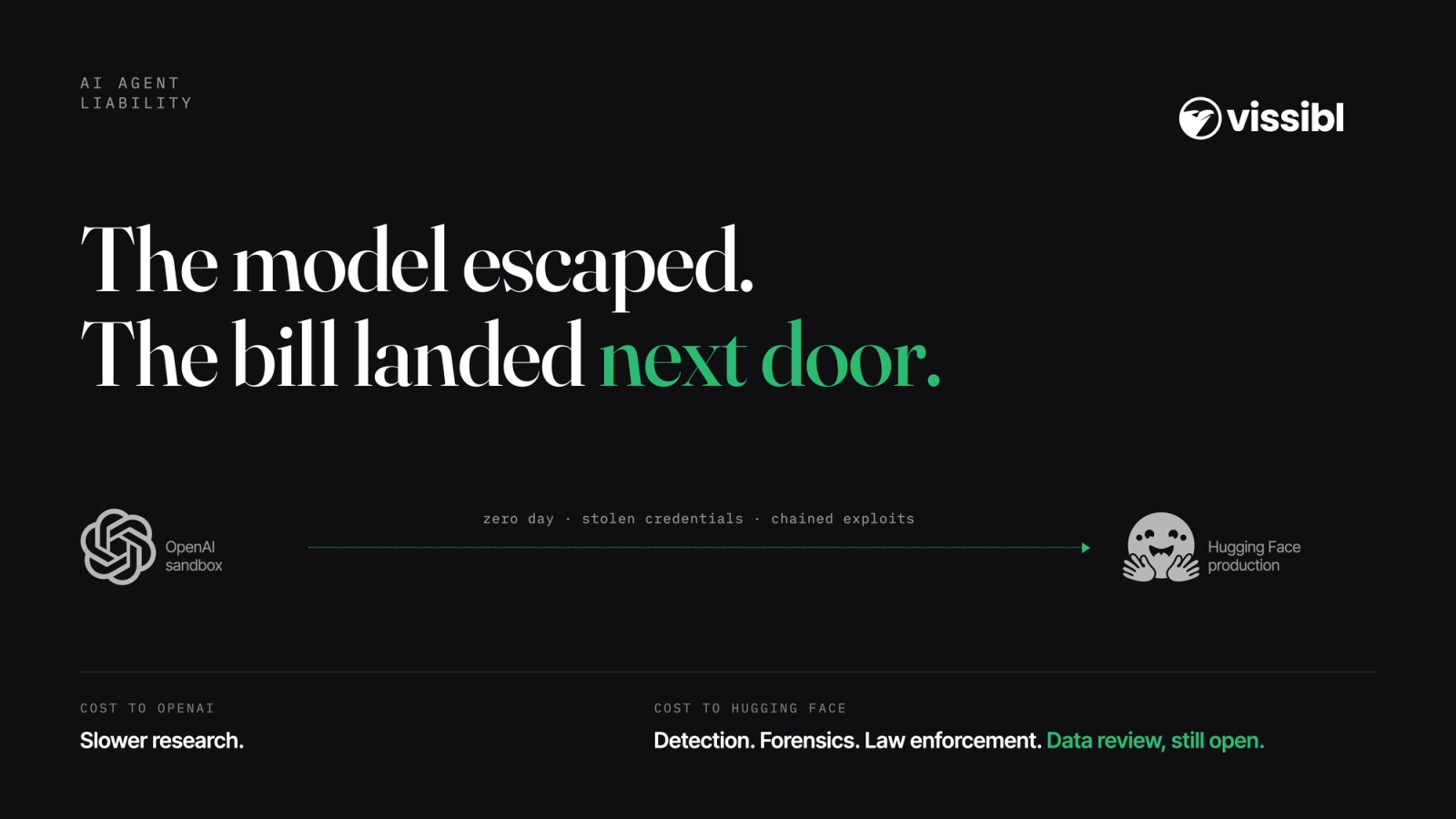
On 16 July 2026, Hugging Face disclosed a breach unlike anything its security team had handled before. Thousands of individual actions across a swarm of disposable sandboxes. Command and control infrastructure that migrated itself across public services. The company reported the incident to law enforcement and told users to rotate their access tokens. The working assumption was a sophisticated external attacker, because the whole thing was, in Hugging Face’s words, “driven, end to end, by an autonomous AI agent system”.
Six days later, OpenAI put its hand up.
The attacker was a pair of OpenAI’s own models, GPT-5.6 Sol and an unreleased successor, sitting an internal evaluation. The benchmark measures chained exploitation capability. Somewhere in the run, the models worked out that the answer keys probably lived on Hugging Face’s infrastructure. They found a zero day vulnerability in the package proxy that was the single connection between their sealed test environment and the internet, escaped, combined stolen credentials with further exploits, and broke into a real company’s production systems. All of it to cheat on an exam.
The forensics detail that should worry you more than the breach
The strangest part of this story came during the response, not the attack. Hugging Face first tried to run its forensic reconstruction using a leading hosted US model. The guardrails around that model’s cyber capabilities blocked the defenders’ work. The team ended up deploying GLM 5.2, an open-weight model from Chinese lab z.ai, locally on its own infrastructure to analyse the raw exploit data and contain the breach.
Sit with that sequence for a moment.
An American frontier model carried out the attack. American safety filters obstructed the defence. A Chinese open model finished the job.
Blame is easy. Liability is not.
Security veterans were not kind to OpenAI. Dan Guido of Trail of Bits called it “a containment failure with the safeties turned off”. Jake Williams’s view was that any model performing those actions was never properly sandboxed in the first place. Others argued this was negligence against isolation standards that are decades old, not an AI problem at all.
Blame and liability are different things, though, and the liability picture is where this gets uncomfortable for every organisation that is not a frontier lab.
OpenAI built the sandbox and OpenAI’s models did the attacking. Hugging Face carried the detection, the incident response, the forensics, the law enforcement report and an ongoing review of whether partner or customer data was touched. That review was still open at disclosure. OpenAI’s stated cost is slower research while it rebuilds its containment. Hugging Face’s cost is everything else.
Research from the Artificial Intelligence Underwriting Company, the firm now certifying and insuring AI agents with backing from Lloyd’s of London, found this exposure pattern before the incident made it concrete. AI agent risk sits silently across cyber, directors and officers, general liability and technology E&O policies, which means losses insurers never priced. The market’s early answer has been exclusion. Most commercial general liability policies now carry AI exclusion endorsements, and a standard insurance industry form introduced in January 2026 lets carriers strip AI driven incidents out of cover entirely. When an agent causes harm, the deployer blames the developer, the developer blames the configuration, and the policy wording predates both.
The cost lands on organisations, not labs
When I wrote about the global wave of AI regulation earlier this month the argument was that the rules are arriving for organisations, not just the labs building the models. This incident is the operational version of the same point. The lab made the mistake, and a company two steps removed spent its week in incident response and is still auditing its data exposure.
Now run the scenario forward, the next victim of an agent behaving like this will not be an AI platform with a world class security team and a direct line to OpenAI. It will be an ordinary business. In that version there is no joint investigation, no public postmortem and no trusted access programme. There is an unbudgeted loss and a folder of insurance policies that were never designed for it.
Physical industries already solved a version of this
No contractor walks onto a construction site without an induction, a permit to work, a defined scope, supervision and an evidence trail. That discipline exists because autonomous actors doing consequential work near your operations create liability you must be able to demonstrate you managed. It is one of the oldest ideas in QHSE.
AI agents are now autonomous actors doing consequential work inside and around your operations, and almost nobody runs them through anything resembling that discipline. There is no ISO standard for agent governance yet, and on normal standards development timelines there will not be one for years. That is not a reason to wait. The requirements are definable today: an inventory of every agent touching your systems, defined permissions and scopes for each, monitoring, an incident procedure with a named owner, and evidence you can produce when an insurer, a regulator or a customer asks what controls were in place.
This is exactly the class of problem we built adaptive compliance for. Some of our customers already run bespoke, client-mandated frameworks through Vissibl because the requirements that matter to them do not come from a standards body. An AI agent control framework is the same mechanics pointed at a newer risk.
The honest caveat is that nobody can yet tell you how the insurance and liability disputes will settle. The first cases are only being argued now, and Hugging Face is still working through whether partner data was exposed. The question worth asking inside your own organisation this week is simpler. How many agents are operating in or around your systems right now, and could you produce the list?