What is ISO 42001 certification software for Australian AI teams?
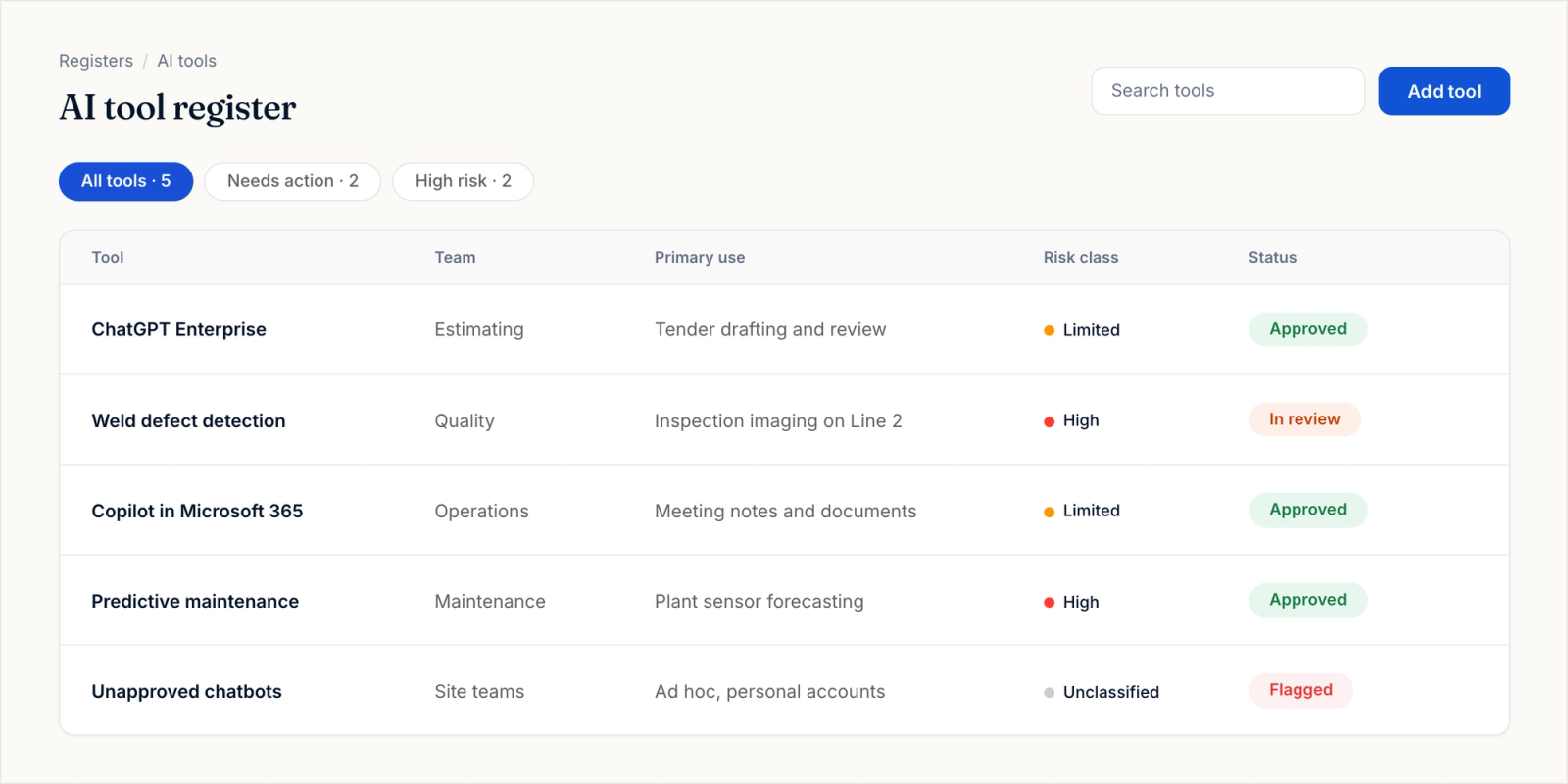
The buyer who won't sign until you can show how your AI is governed usually turns up long before any certification body does. It's a Tuesday, someone from their security team sends through a questionnaire, and by question nine they're asking for your AI system inventory, the intended use of each one, who can override the model, what data it sees, and the vendor terms for the model you didn't build. Your product lead reads it, scrolls back up, reads it again. Then the deal goes quiet while three people spend a fortnight assembling answers that should already have existed.
That's the stake. Not a certificate. A live commercial conversation that stalls because the evidence doesn't exist yet.
ISO 42001 is the international standard for an artificial intelligence management system (AIMS). It isn't an environmental standard. That's ISO 14001. If a page mentions emissions, sustainability or a construction yard while claiming to explain 42001, it's describing the wrong standard entirely, and you should close the tab.
This article's for Australian organisations that build or use AI and now have a buyer, a board or a tender asking how that AI is governed. It covers what ISO 42001 actually is, what certification software needs to track, why slide-deck governance falls over, and how a continuous AIMS programme differs from a one-off pack assembled under pressure.
What is ISO 42001 (AI management) vs ISO 14001?
ISO 42001 sets out requirements for establishing, implementing, maintaining and continually improving an AI management system. The object of that system is how your organisation directs and controls AI: what's running in production, what it's meant to do, the risk and impact, human oversight, the data, the suppliers, and what changes when you ship.
ISO 14001 is the environmental management system standard. Environmental aspects, impacts and compliance obligations. It has nothing to do with model governance.
Mixing the two up isn't a small wording slip. Buyers searching for ISO 42001 software, ISO 42001 certification Australia or AI management system software want AIMS evidence, not an EMS. Certification bodies and enterprise security teams pick up the error within about a minute of reading your materials, and it costs you credibility you then have to earn back.
An AIMS generally needs to cover:
- Inventory of AI systems, both built and bought, and what each is intended to do.
- Roles and accountability, including human oversight wherever decisions carry weight.
- Risk and impact assessment tied to how the AI is actually being used, not how it was described at launch.
- Data the systems see, retain and share.
- Vendors and models you didn't build, including their terms and the residual risk you're carrying.
- Policies and controls that match what's in production rather than what was promised in a pitch.
- Change, monitoring and continual improvement every time something new ships.
If you go for the certificate, it runs on the familiar ISO shape: a three year cycle with annual surveillance through a certification body, normally JAS-ANZ accredited here in Australia. But the harder deadline for most teams isn't Stage 1. It's the first customer review that asks for the system months before anyone's even booked an auditor.
What does ISO 42001 certification software need to track?
AI management system software isn't a model-hosting stack or a slide repository with a new label on the folder. It's the programme that keeps AIMS evidence current so you can answer a buyer or a certification body without rebuilding the whole story from scratch each time.
At minimum it should track:
- AI system inventory with intended use, status and owner.
- Clause mapping of policy and evidence against the actual ISO 42001 requirements.
- Named owners on every system, every control and every action.
- Risk and impact records that update when the use case or the data changes.
- Vendor and model dependencies, including third-party terms and residual risk.
- Human oversight arrangements wherever the standard and your own risk assessment call for them.
- Change history when a new model, feature or data source goes into production.
- Internal audit, non-conformances and management review sitting in the same programme as the controls, not in a separate spreadsheet somebody maintains out of habit.
- Readiness for a customer questionnaire or a CB visit without a fortnight of theatre first.
If a tool can't show you which AI systems you're running today, who owns them, and where the evidence for each relevant clause lives, then it isn't certification software for 42001. It's a document store.
Why slide-deck AI governance fails buyers
The AI story usually lives in a pitch deck. There's no inventory. No owner attached to the model already sitting inside the product. No record of what data it sees. The vendor's terms are in someone's inbox from eight months ago. So when the customer asks for evidence, the team writes it that week, and everyone knows they're writing it that week.
That's point-in-time theatre, and it doesn't survive the next question.
Enterprise buyers and tenders don't ask whether you care about responsible AI. Nobody's ever failed that question. What they ask for is:
- A list of AI systems in scope for the engagement.
- Intended use and known limitations.
- Who can override or stop the system.
- What personal or confidential data the model processes.
- Which third-party models or APIs sit in the chain.
- How you assess and treat risk when the use case shifts.
- Evidence the controls actually ran after go-live, not only at launch.
A slide can narrate all seven of those once. It can't keep them true when product ships every sprint. It's the same failure mode you see in ISO 27001 programmes that only wake up a fortnight before surveillance. For 42001 the trigger tends to be a procurement questionnaire rather than a CB date, but the gap underneath is identical. No continuous programme, just a rebuild under pressure, every time.
How Australian ISO 42001 certification usually runs
Teams that do go for the certificate follow much the same management-system path as any other ISO standard:
- Gap analysis against ISO 42001.
- AIMS build: scope, AI inventory, policy set, risk and impact assessment, controls and evidence.
- Internal audit and management review.
- Stage 1 and Stage 2 with a JAS-ANZ accredited certification body.
- Certificate, typically three years, with surveillance audits each year.
Software that helps you write the first policy pack and then goes quiet while product keeps shipping new models leaves you exposed twice: at the next buyer review, and at the next surveillance visit. A continuous AIMS programme matches how the standard is written and how buyers actually buy.
ISO 42001 software vs generic GRC or QHSE tools
Generic GRC and QHSE platforms can store policies well enough. What they usually don't do is start from an AI system inventory or from ISO 42001 clause language. AI management system software has to treat models, prompts, vendors and human oversight as first-class objects, then map the evidence back to the AIMS requirements.
That's why bolting "AI governance" onto an environmental or WHS module falls over. ISO 14001 and site safety tools solve genuinely different problems, and they solve them well. ISO 42001 certification Australia searches are after AIMS readiness: inventory, risk, oversight, data and supplier controls that stay current long after go-live.
If you're already running ISO 27001 or ISO 9001, the shape worth having is one continuous programme with 42001 alongside them. Not a third Drive folder and a second consultant's spreadsheet.
How Vissibl runs the AIMS programme
Vissibl is an AI-native compliance platform for operational businesses in Australia and the GCC. It adapts to whatever framework you run, so ISO 42001 sits beside ISO 27001 or ISO 9001 if you hold those too, inside one programme rather than three separate drives.
You bring the AI you already run, even if the list is messy and half of it's in someone's head. Vissi Audit reads the documents you've got, maps them against the actual 42001 clauses, and returns a gap list ranked by risk. Every AI system and every control carries a named owner. When something new goes into production, the picture updates, so the answer to the buyer's next question is already on the dashboard instead of being written the week they ask for it.
Unlimited users and unlimited sites. From $12,000 AUD per framework per year. Implementation included. No setup fee. No per-seat charges.
Vissibl doesn't replace your model-hosting stack and isn't trying to. It runs the management system the buyer and the certification body actually ask for.
See what's missing before the customer asks
Bring the list of AI you already run. In the first session we run a live gap view against your own documents, and you see what's missing before you commit to anything.
Book a demo when you want that reading on your own systems rather than on a generic AI governance checklist.