What Is an AI Governance Framework and Why Regulated Businesses Need One Now
An auditor asks a quality manager a simple question. "You flagged that batch of non-conformances using an AI tool. Who reviewed its output before you acted on it, and where is that recorded?" The manager knows the tool has been running for months. Nobody can point to where the sign-off lives, because there was never a process to capture it. That is not a technology problem. It is a governance gap, and it is becoming a common one.
AI is moving faster than most compliance programmes were built to handle. Regulated businesses are already using it across document processing, predictive maintenance, vendor screening, and quality management. The governance that should sit around those tools is usually missing, vague, or borrowed from IT security policies that were never written with AI in mind.
Regulators, prime contractors, and certification bodies have started asking pointed questions. How is AI being used? How are AI-assisted decisions checked? Who is accountable when one goes wrong? If the honest answer is a shrug, that is the exposure. This article sets out what an AI governance framework actually is, what it needs to contain, and why the businesses that build one now will be the ones still standing when the questions get harder.
What an AI Governance Framework Actually Is
An AI governance framework is a structured set of policies, controls, accountabilities, and processes that govern how your organisation uses AI. It defines which tools are in scope, how they are assessed before they go live, how their outputs are monitored, and what happens when they produce errors.
It is not a single document you write once and file. It is a programme that runs across risk management, data governance, human oversight, vendor due diligence, and audit readiness. Done well, it maps onto the compliance frameworks you already run rather than sitting off to the side as its own initiative.
The simplest way to think about it is as the documented answer to three questions any auditor or major client might put to you:
- What AI tools does your organisation use, and how were they approved?
- How do you monitor AI outputs for accuracy, bias, and safety risk?
- Who is accountable when an AI-assisted decision causes harm or a non-conformance?
If you cannot answer those with evidence, you do not have a governance framework. You have an assumption, and assumptions do not survive audits.
"If you cannot answer those with evidence, you do not have a governance framework. You have an assumption."
Why Regulated Businesses Are Exposed Right Now
Most compliance programmes were built around fixed standards. ISO 9001, ISO 45001, ISO 27001, API Q1, and their peers. All of them predate AI being embedded in daily operations. They handle processes, documentation, and management systems well. They do not automatically account for the specific ways AI can fail.
Meanwhile the adoption keeps climbing. Quality teams lean on AI to flag non-conformances. Safety teams use it to read incident data. Procurement runs it over vendors. Each use carries risk, and most of that risk currently sits untracked, which is the part that should worry you. An untracked risk cannot be reviewed, cannot be improved, and cannot be shown to an auditor as handled.
The pressure is not only regulatory. Prime contractors and major clients are writing AI governance requirements into supplier qualification. This is the familiar supply-chain pattern: a principal contractor's demands run ahead of the published standard and catch suppliers off guard. It is now repeating with AI. You could hold every certification on the wall and still fail to satisfy a client mandate because your management system says nothing about how you use AI.
"You could hold every certification on the wall and still fail to satisfy a client mandate."
What a Practical AI Governance Framework Needs to Cover
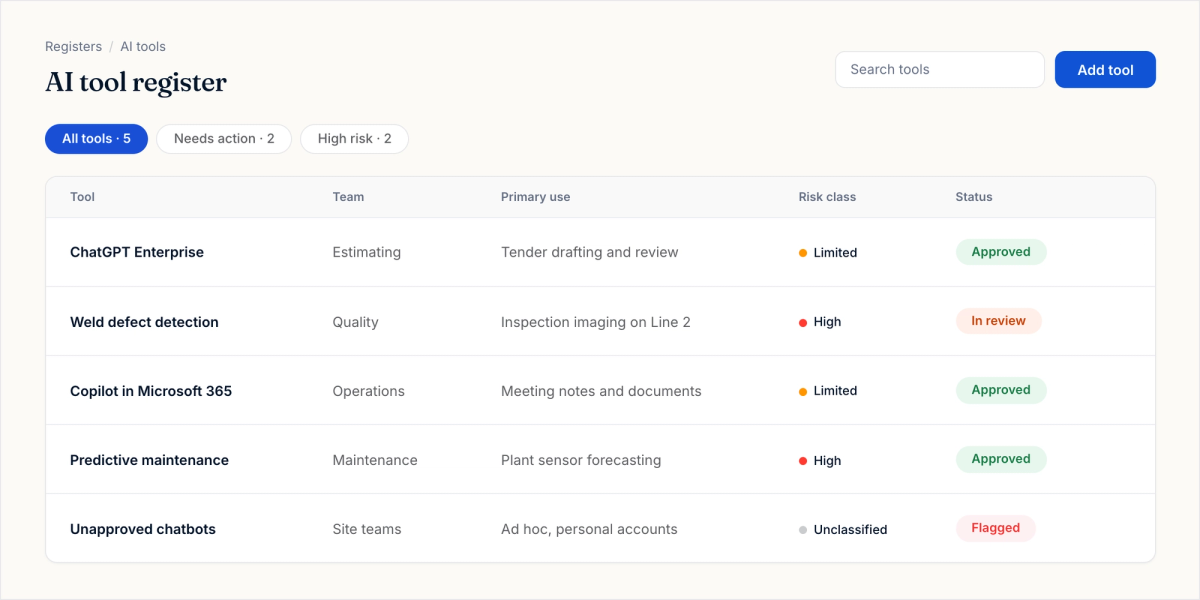
An Inventory of AI Tools in Use
You cannot govern what you have not written down. Start with a complete inventory of every AI tool in use, including the ones buried inside third-party software where you might not think to look. Each entry records what the tool does, what data it touches, who owns it, and what decisions it shapes.
Everything else builds on this. Get it wrong and your risk assessment, vendor due diligence, and audit evidence are all built on sand. This is also the part that quietly rots, because new tools get adopted faster than any register gets updated. Keeping it honest is ongoing work, not a one-off.
Risk Classification
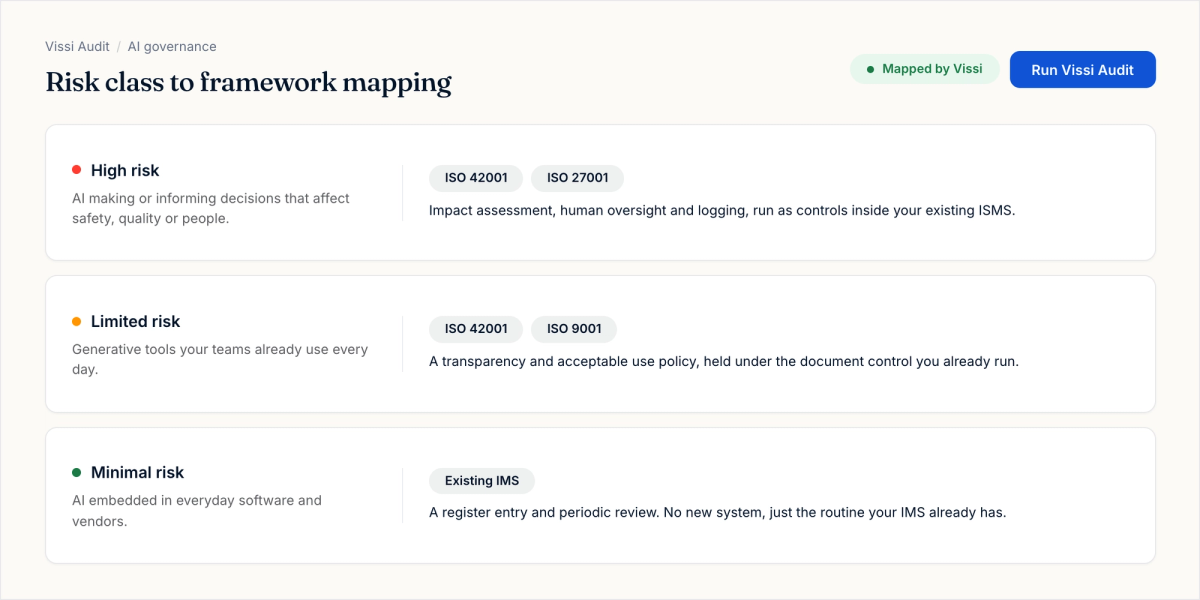
A tool that drafts internal emails is not in the same league as one that flags a safety-critical anomaly or writes compliance documentation. Your framework needs a way to assign risk levels based on the consequence of an error, how much human oversight sits in the loop, and how sensitive the data is.
That classification then drives everything downstream. High-risk use earns tighter controls, more frequent review, and a clear escalation path. Low-risk use should not drown in the same paperwork, or people will stop cooperating.
Human Oversight and Accountability
Every AI-assisted decision that materially affects safety, quality, or compliance needs a named human accountable for reviewing and approving it. Auditors want to see that outputs are checked, not waved through. Your framework should define the oversight roles, the review procedure, and what counts as a sound basis for accepting or overriding an AI recommendation.
Vendor and Third-Party AI Risk
If a vendor's platform uses AI to process your data or influence your operations, that AI is inside your risk perimeter whether you chose it or not. Your vendor process needs AI-specific questions. What models does the vendor run? How are they validated? What are the error rates? Who carries liability when the AI gets it wrong? This is an extension of the vendor risk work already in your programme if you run ISO 9001 or ISO 27001, not a new discipline.
Incident and Non-Conformance Tracking
When an AI tool produces an error that hits quality, safety, or compliance, it needs to be captured, investigated, and closed out like any other non-conformance. Define what counts as an AI-related incident, how it gets reported, and what corrective action looks like. Skip this and AI errors stay invisible to your management system, which means you never learn from them and can never show an auditor you handled them.
Audit Evidence and Documentation
Governance only counts if it is auditable. Every control needs evidence behind it: policies, risk assessment records, training logs, incident reports, vendor assessments, review sign-offs. That evidence has to be version-controlled, findable, and tied to the specific control it supports. Evidence you cannot locate during an audit may as well not exist.
Where ISO 42001 Fits
There is now a dedicated standard for this. ISO/IEC 42001, published at the end of 2023, is the first international AI management system standard. It is built on the same structure as ISO 27001, so if you have run an ISMS the shape will feel familiar: an AI policy, defined roles, risk and impact assessments, controls across the AI lifecycle, and continual improvement. It is certifiable, and certification bodies are beginning to offer it.
So does a published standard close the gap? Not on its own, and this is where teams trip. ISO 42001 gives you the management-system scaffolding. It does not hand you the specific AI clauses a given prime contractor or regulator will demand. Certification is still early, so few auditors and few businesses have been through it yet. And it sits alongside your existing certifications rather than replacing any of them, so you still have to thread it into the IMS you already run.
We are working through ISO 42001 ourselves at Vissibl, which is part of why this reads as a practical view rather than a theoretical one. Adopting it is worth doing. It is not a reason to wait, and it is not a substitute for governing the AI you are using today.
How AI Governance Maps to Your Existing Compliance Frameworks
The most common mistake is treating AI governance as a standalone project. It maps directly onto controls you already operate. ISO 27001 covers information security risk, which includes AI systems handling sensitive data. ISO 9001 covers process control and non-conformance management, both of which apply to AI-assisted quality decisions. ISO 45001 covers hazard identification and risk assessment, which now has to account for AI used in safety-critical settings. Run any of these and your AI governance work belongs inside that system, not beside it.
The snag is tooling. Most compliance platforms are built around fixed catalogues of recognised standards. They will happily manage ISO 27001 or ISO 9001, but they cannot ingest a client-mandated AI requirement that falls outside the catalogue, and they are slow to absorb something as new as ISO 42001. That is exactly where businesses running bespoke or client-specific frameworks get stranded.
Adaptive compliance is built for that situation. Instead of locking you into a fixed list, it runs the framework you are actually being assessed against, whether that is a recognised standard, a regulator's requirement, or a prime contractor's mandate. That matters most while AI governance is still moving and no single published standard covers everything a client will ask for.
The Cost of Waiting
There is a version of events where you wait for the market to settle, lean on ISO 42001 certification alone, and build your programme once things are clear. That patience has paid off in other compliance areas. Here it is getting expensive.
The EU AI Act is in force and phasing in obligations through 2026. Regulators across the UAE, Australia, and the wider GCC are publishing their own AI guidance. Client mandates already carry AI clauses. And certification bodies have started asking questions in audits that a pre-AI IMS simply cannot answer. None of this is waiting for you to be ready.
"None of this is waiting for you to be ready."
If your compliance programme already runs continuously, with live gap analysis and a risk register mapped to your active frameworks, adding AI governance is mostly a matter of loading the requirements and tracking evidence against them. The part that stays genuinely hard is keeping the AI inventory honest as tools change underneath you, and that is true whether you run it by hand or in a platform. If your programme is still built around a scramble before each audit, AI governance is one more reason that model is running out of road.
For teams extending an existing system, the approach to adding ISO 27001 to an existing management system is a useful template. Map new controls onto what you already have, close the gaps, and run it continuously rather than as a one-off project.
Getting Started Without Overcomplicating It
You do not need a perfect framework on day one. You need a defensible one you can show is active and improving.
Start with the inventory. Document every AI tool and give each an owner. Run a risk assessment against your existing controls to find where AI use opens gaps. Feed those gaps into your non-conformance and corrective action process. Write down your oversight procedures. Add AI questions to your vendor assessments. If you later decide to pursue ISO 42001, this same work becomes the backbone of your AI management system, so none of it is wasted.
That is a governance framework. Not complete, but auditable, improving, and wired into the programme you already run. Continuous compliance tools make it far easier to sustain, because they keep your evidence current and your readiness live rather than demanding a manual push before every audit.
FAQs
What is an AI governance framework?
An AI governance framework is a structured set of policies, controls, accountabilities, and processes that govern how an organisation uses AI. It covers AI tool inventory, risk classification, human oversight, vendor due diligence, incident tracking, and audit evidence.
Is AI governance required by ISO standards?
ISO/IEC 42001, published in 2023, is a dedicated AI management system standard and is now certifiable. The older standards you may already hold, including ISO 9001, ISO 27001, and ISO 45001, have no specific AI clauses, but AI use falls within their existing risk management, process control, and information security requirements. Regulators and clients are increasingly adding AI-specific requirements on top of all of these.
What is ISO 42001?
ISO/IEC 42001 is the first international standard for an AI management system. It is structured like ISO 27001 and sets out requirements for an AI policy, risk and impact assessments, lifecycle controls, and continual improvement. It gives you a recognised scaffold for governing AI, though it does not replace the AI clauses individual clients or regulators may still require.
How does AI governance fit into an existing IMS?
AI governance controls map directly onto controls already present in most management systems. Risk assessment, non-conformance tracking, vendor management, and document control all apply to AI use. The most efficient approach is to extend your existing IMS rather than build a separate AI governance programme alongside it.
What happens if a supplier or contractor does not have AI governance in place?
Prime contractors and major clients are starting to include AI governance requirements in supplier qualification and audit processes. A supplier without documented AI governance may fail a client audit or be unable to satisfy a mandate, even while holding every relevant certification.
How often should an AI governance framework be reviewed?
AI tools and their risks change quickly. Review the framework at least annually, and monitor controls tied to high-risk AI use continuously. Linking AI governance to a live compliance programme rather than a periodic review cycle is the most reliable approach.
What is the difference between AI governance and AI ethics?
AI ethics is about the values and principles that should guide how AI is built and used. AI governance is the operational implementation of those principles: the policies, controls, and accountabilities that make them auditable and enforceable in a business.
Do small and mid-sized businesses in physical industries need an AI governance framework?
Yes. The risk is not confined to large enterprises. Any regulated business using AI in quality, safety, or compliance faces the same questions. The programme can scale to the size of the organisation, but the need for documented, auditable controls does not depend on size.
Auditors and clients are already asking the hard questions. The businesses treating AI governance as part of the compliance programme they already run will be the ones with an answer ready when the questions land on them. Learn more at vissibl.ai.