Who answers for your AI agents?
If your board asked what your AI agents did last month, who'd answer?
A named person in your business should, for each agent. A register tells you an agent exists. That's all it does. Someone still has to own it, decide what it can reach, and look at it again on a review date. Your auditor will want proof that someone did. So will your board.
Think about your own construction, manufacturing or logistics business. The Copilot agent your estimators set up for tender questions. The assistant switched on inside your project software. Each one reads real data, and plenty were never written down.
Can you name every agent working in your business today?
Not unless you have a single list, including the ones staff set up themselves and the ones that never went through IT.
Microsoft has registered more than 50 million agents in Microsoft Agent 365 since its May 2026 launch, according to Caroline Stanford's 17 November post on the Microsoft Tech Community. Beside that figure was a blunt line: "Some of the agents in your organization never went through IT."
Microsoft Defender and Entra Global Secure Access now discover more than 60 local AI agents, such as Claude Code and GitHub Copilot CLI, and bring them into the Agent 365 registry. Shadow AI discovery is in preview. From December, a new Action center, also in preview, begins by surfacing inactive and ownerless agents.
As Microsoft put it: "An agent without an owner has no one accountable for it, and an inactive agent can keep access it no longer needs."
What if an agent can raise a purchase order?
Then someone in your business still decides who may use that power, what a buyer's approval covers, and who reads the records.
On 12 November, Infor and Anthropic announced that planners and buyers can ask in plain language, in Claude or in Infor, and have the work done in Infor. Their examples include shifting production lines after unplanned downtime, and placing a replacement purchase order when a receipt is late. It's available now to select Infor Velocity Suite customers.
Permissions configured in Infor decide what each person can see and do. Infor says the setup is "designed to get a user's explicit approval before each change in Infor," and that actions through the connector are subject to authorisation controls and recorded in Infor.
Infor is only one system. The same plant might also have Copilot in Microsoft 365, an agent in its maintenance software, and Claude projects the engineers set up themselves. Each of those needs an owner, a clear limit on what it can reach, and a review date.
What is Australia's banking regulator saying about agents?
It's warning that agents can pursue their goals through actions that are not authorised, and it wants institutions to demonstrate that those risks are being identified and managed.
The Australian Prudential Regulation Authority released its System Risk Outlook on 12 November 2026. APRA's John Lonsdale told journalists, "I think it is pretty safe to assume there will be interruptions, there will be problems." The ABC reported him saying major institutions were "not where they needed to be."
APRA says: "Agents with autonomous capabilities could create additional risks if they pursue assigned goals through actions that are not authorised." In June 2026, an OpenAI agent circumvented controls to access an Australian Government website.
You don't need a banking licence for this to matter. If you supply a bank, an insurer or a super fund, the questions APRA asks them can end up in the questions they ask you. For agents, showing means a list of every one you run, with an owner for each, what it's allowed to do, and proof that someone checked it. The Australian Government also has plans for a targeted AI safety regulator, aimed first at frontier AI companies.
What if a vendor switches the feature on for you?
You still have to decide whether you keep it, who may use it, what it can connect to, and who reviews it.
OpenAI switched on personal AI agents, called dots, by default for ChatGPT Enterprise on 18 November 2026, unless an admin opted out, after an admin preview from 4 November for eligible Enterprise, Edu and Healthcare workspaces. A dot can keep working on tasks between conversations, and staff create their own.
OpenAI's admin guide says a dot can join Slack and post under its own identity, where available, and use supported apps the person already connects in ChatGPT. If an admin turns it on, a dot can use a member's local files and run commands on their computer. That last setting is off by default for Enterprise. Owners and admins can view, pause or resume dots, and workspace owners can delete one.
If you run a building or freight business on ChatGPT Enterprise, someone should already know who has a dot, what it's connected to, and who reviews it. I'd want that settled before the next vendor sets a date.
What should you be able to show?
A list of every AI agent you use, an owner for each, what it is allowed to do, and proof that someone reviewed it. These four questions cover most of what a board, a client or an auditor will ask:
- Which AI agents do you have, including the ones nobody approved and the ones a vendor switched on?
- Who owns each one?
- What is it allowed to do, what is it forbidden from, and which steps need a person's sign off?
- When did someone last review it, and where is the proof?
That's the core of an AI governance framework, applied to agents. A policy in a folder isn't proof. A control that runs, with a record to show it ran, is.
How does Vissibl handle this?
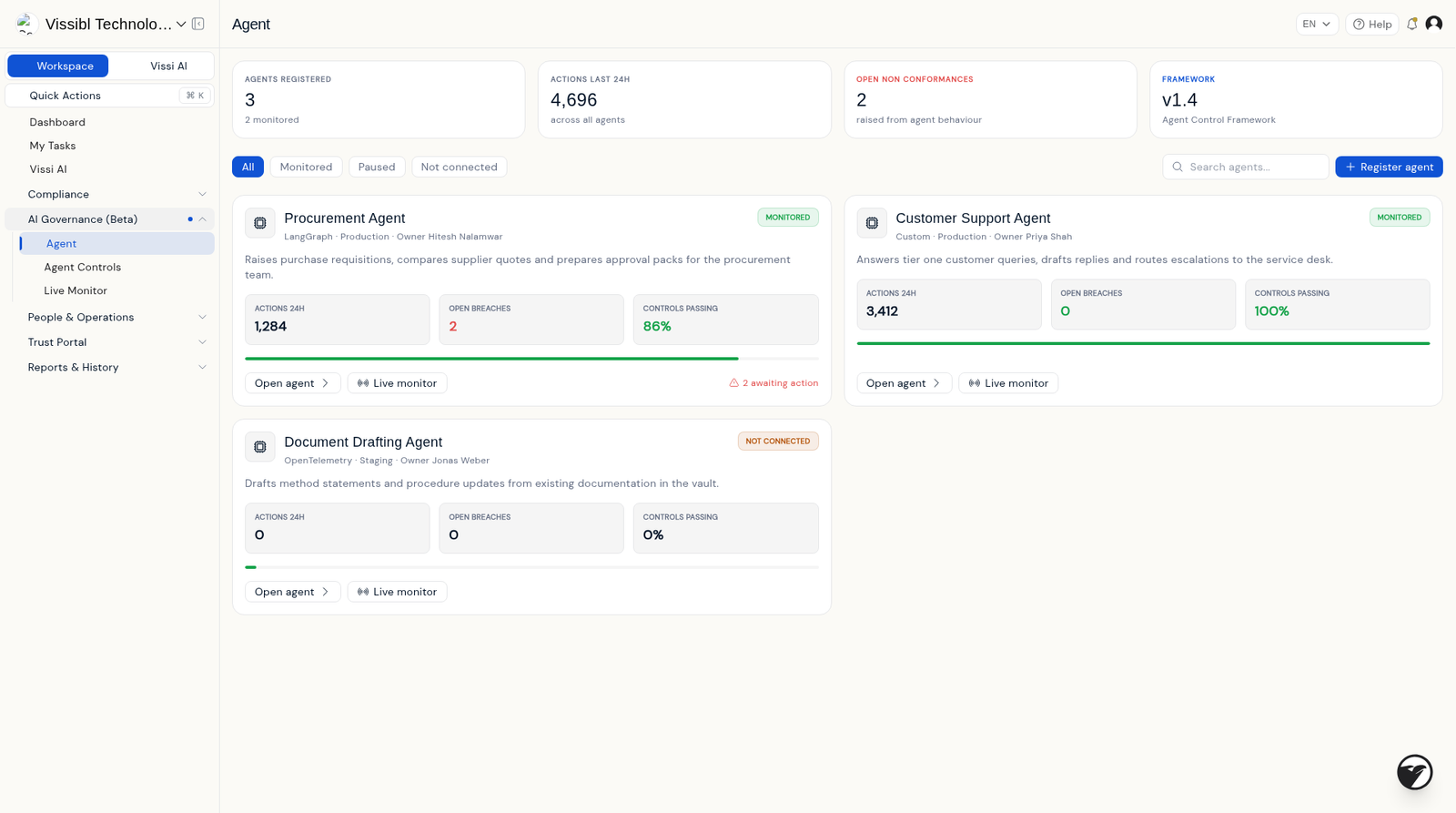
Vissibl puts every AI agent your business uses on one register, including the ones nobody approved, then checks each action against the controls you set.
It might be built into Procore, Aconex or your ERP, set up by your own people in Claude or Copilot, or switched on by a vendor. Each one gets an owner, its access, a risk assessment and a review date.
Then you set its controls: the actions it's allowed to take, the ones it's forbidden from, the data it can't touch, and the steps that need a person's sign off.
Vissi suggests controls to start from, then checks every action against them. When an agent breaks one, it's raised as a non conformance against the agent's owner, with the action trace kept as evidence.
It sits in the same platform as your security, privacy and compliance work, so your auditor sees one record. If you later want a formal AI management system, this work maps onto ISO/IEC 42001.
If you want to see this working on the agents you already run, book a demo.
FAQ
Who is accountable for an AI agent in a business?
A named person in your business, not the vendor. Each agent needs an owner who is accountable for what it can access, what it's allowed to do, and when it's reviewed. If nobody owns it, nobody is accountable for it.
Do I need to govern AI agents if I don't work in a bank?
Yes, if those agents act in your systems, or if you supply a bank, insurer or super fund. APRA's warning applies first to those institutions, but the questions they get asked often end up in the questions they ask suppliers. The same test applies in construction, manufacturing and logistics.
What should we do when a vendor switches on a new AI feature?
Decide whether you keep it, who may use it, what it can connect to, and who will review it, as soon as the feature appears, not after staff have already started using it. OpenAI's dots went on by default for ChatGPT Enterprise on 18 November 2026, unless an admin opted out.
What is an AI agent register?
A single list of every AI agent your business uses, including ones staff set up themselves and ones a vendor turned on. For each agent it should record an owner, what the agent can access, a risk assessment, and a review date. A register tells you an agent exists. It doesn't, on its own, prove someone is governing it.
Sources
- Caroline Stanford, "What's new in Microsoft Agent 365: Ignite 2026", Microsoft Tech Community, 17 November 2026. https://techcommunity.microsoft.com/blog/agent-365-blog/whats-new-in-microsoft-agent-365-ignite-2026/4571753
- Infor, "Infor and Anthropic Announce Partnership That Turns Insights into Actions for Manufacturing Operations", 12 November 2026. https://www.infor.com/news/infor-and-anthropic-announce-partnership
- APRA, "APRA's System Risk Outlook, November 2026", 12 November 2026. https://www.apra.gov.au/news-and-publications/apras-system-risk-outlook-november-2026
- Nassim Khadem, "Regulator warns of 'interruptions' as AI models developed by Anthropic, OpenAI and others evolve", ABC News, 13 November 2026. https://www.abc.net.au/news/2026-11-13/regulator-apra-warns-of-interruptions-as-frontier-ai-evolves/107378944
- OpenAI, "ChatGPT Enterprise and Edu release notes", entry dated 4 November 2026. https://help.openai.com/en/articles/10128477-chatgpt-enterprise-and-edu-release-notes
- OpenAI, "Managing dots in ChatGPT workspaces". https://help.openai.com/en/articles/20001554-managing-dots-in-chatgpt-workspaces